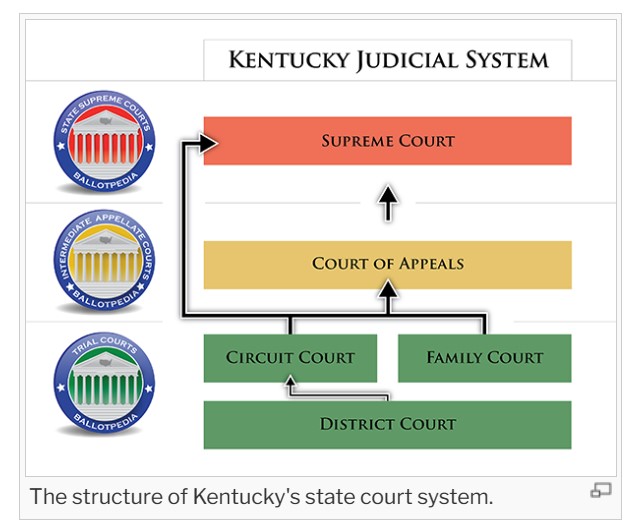
BREAKDOWN OF FILINGS
There were FOUR separate cases related to the Chandler case. The subsequent cases were brought about, as the direct result of actions taken by Attorney Brucie Moore, Attorney Steven Downey, rulings of Judge Rene Williams, and Judge Daniel Heady. Along with the Administrative Office of the Kentucky Court of Appeals, and the Court of Appeal Judges, who actually participated in this atrocity.
The following is a QUICK RUNDOWN:
CASE ONE: ➡️ BLUE District Probate Court Case # 11-P-00050; — Circuit Court Case # 11-CI-000150 ; and Kentucky Court of Appeals, Case # 2014-CA-000963-MR –Discretionary Review with Kentucky Supreme Court Case in 2018, Case #______________________
CASE TWO: District Probate Case # 07-P-00090 ; Appeal to Circuit Court CASE # 15-XX-00005; Court of Appeals Denial of Discretionary Review Case #2015-CA-001182.
CASE THREE: Circuit Court Case # 15-CI-00033
CASE FOUR: Court of Appeals Discretionary Motion # 2015-CA-00118 this case links back to District Court Case# 07-P-00090 and Circuit Court Appeal Case #15-XX-00005
The case began with as a Petition to Crittenden District Probate Court, Case # 2011-P-00050, challenging the original submission of a copy of the will. There it was brought to the attention of District Court Judge Daniel Heady, that the personal property in the family residence was never divided among the two brothers, and that on the night Keith Chandler’s body was discovered, the Defendant’s had already returned to the family home on several occasions with a truck and trailer, and were removing personal property and personal family heirlooms from the joint Newcomb/Chandler family’s 200 year old, 7 generation family farm.
July 20, 2011 – – Crittenden District Probate Judge, Daniel Heady, instructed Steve Chandler that he had to file a Will Contest in Circuit Court, and bring his claim for his legal vested interest in the personal property contained in the residence, within his Will Contest Complaint filed with the Crittenden County Circuit Court, in front of Judge Renee Williams.
October 7, 2011, on behalf of my client, I filed a WILL CONTEST Complaint in Crittenden Circuit Court, Judge Rene Williams, Case # 11-CI-000150.
Notice the Complaint was filed on three grounds,
- Lack of Mental Capacity
- Undue Influence
- Unnatural Disposition.
- Undue Influence
The Complaint filed in Crittenden County Circuit Court, in October of 2011, included an Equity Claim, for my client’s legal vested interest in the personal content of the home, farm equipment, property contained in storage and old farm residence, which remained on the property. My client legally inherited the personal content from his mother’s will. District Court Probate Case # District Probate Case # 07-P-00090; Appeal to Circuit Court Case # CASE # 15-XX-00005; Court of Appeals Discretionary Review Case #2015-CA-001182-DR (Discussed in greater detail below, under the heading Case 2.)
Rather than filing an Answer to the Complaint, Union County Attorney Brucie Moore, filed a Motion to Strike 60% of the Complaint, including Chandler’s Equity Claim to obtain a Constructive Trust, to protect his family’s memorabilia. (Attorney Brucie Moore, was present in District Court, when Judge Heady instructed Chandler, to raise the issue concerning the personal property within his Circuit Court Complaint. There was a hearing on Attorney Moore’s Motion in December, 2011. At that hearing, it was beyond obvious, that Judge Williams had already formed an opinion about the case, despite having no information being submitted from either side.
On April 17, 2012, Judge Williams issued an Order, Striking Everything that Moore requested to be stricken, including his Equity Claim. The Strike Order left no reasonable doubt, as to Judge Rene Williams premature opinion, and evidentiary order in the case. Judge Williams limited all admissible evidence and testimony to a narrow two-year temporal time frame surrounding the alleged execution of the Will on October 23, 2006.
In the state of Kentucky an Order issued pursuant to a Motion to Strike, completely removes all material from the record, as if it was never presented. Therefore, I filed a Kentucky Rules of Evidence 103, to preserve Chandler’s arguments, for appeal.
Attorney Moore directly threatened Chandler with an Abuse of Process claim, during the initial Probate hearing. Specifically stating that Chandler had a farm of his own, and a lot to lose if he proceeded with filing a Will Contest.
In May of 2012, Moore filed an Answer to the few remaining paragraphs and included a Counterclaim for Abuse of Process. The Counterclaim set out endless lies, and fabricated content. The Abuse of Process Counterclaim did not assert any damages, rather it speculated that there could be an increase in inheritance taxes, due to Chandler filing a Will Contest. I filed a Motion to Dismiss the Counterclaim for failure to state a claim, upon which relief could be granted. (i.e. speculated increase in inheritance taxes, cannot be used to establish the element of damages in a complaint)
We had a hearing in June of 2012, Moore and I both submitted memorandums/briefs, for our reported sides. August 9, 2012, Judge Williams issued an Order Denying Motion to Dismiss Abuse Process Counterclaim, setting out that the law does not allow her to have an opinion at this stage in the game.
DESPITE THE FACT THAT SHE CLEARLY HAD AN OPINION DURING THE DECEMBER 2011, Hearing, and even more so within her April 17, 2012, Order Striking 60% of Chandler’s Complaint.
Judge Williams issued a Second Order on the same day, “Sua Sponte,” meaning she is acknowledging that her second Order was not issued pursuant to a Motion from any party. However, she is issuing an Order on her own accord. In the second order, Judge Williams, OVERRULED Chandler’s KRE 103, filing from April, 2012, that was specifically filed just to preserve the content of the paragraphs that were stricken from Chandler’s Complaint. SEE WILL CONTEST PAGE FOR GREATER DETAIL
Less than two and half weeks before trial, Steven Downey was illegally retained by the Estate for $20,000. Downey filed several Motion in Limines, but the most noteworthy one, was the Motion in Limine to exclude all previously stricken testimony and evidence, in accordance to Judge Williams Strike Order issued on April 17, 2012, that she issued even before she made the defendants file their answer.
I had repeatedly expressed concerns to Judge Williams and Moore about Attorney Moore, staying on the case despite knowing she would be a necessary witness during trial, and despite being named as a witness, early on. Moore insisted that she was allowed to stay on the case, until it was established that there is going to be a trial. Please note, that there has recently been a change to that ethical rule, along with others pertaining to actions of Moore and Judge Williams.
“A lawyer shall not accept employment in contemplated or pending litigation if he knows or it is obvious that he or a lawyer in his firm ought to be called as a witness” except if the lawyer’s testimony relates to (1) an uncontested matter; (2) a matter of formality … THE PREVIOUS VERSION

As early as 2012, Brucie Moore was asserting that she did not have to recuse herself from the case, unless the case goes to trial. Brucie Moore waited until less than three weeks before trial, to announce that the Estate has retained Attorney Steven Downey from Bowling Green, Ky. Which resulted in three all day hearings, on Downey’s Limine motions, a matter of days before trial.
Judge Williams essentially gave Chandler a jury trial, while excluding all of his evidence and purported testimony, the same as she did to his Complaint. Judge Williams played the role of a GATEKEEPING RAINMAKER, when sent us to trial with both hands tied behind our backs.
Moreover, since she ruled that October 23, 2006, the day of the execution of the will was the cutoff date, she refused to allow me to question the Defendants about their actions after finding the deceased. (Which goes to establish unnatural disposition.)
Judge Williams was fully aware at the onset, that the narrow two-year temporal reference she established to be admissible evidence, within her Order Striking from the Complaint, was the only time these two co-workers, had their thumbs pressed tightly down on Keith, and neither one of them had any kind of relationship with the family.
I was not permitted to question Brucie Moore about her continued financial interest in the case, or about the fraudulent Abuse of Process Claim, because Downey verbally dismissed it, three days before trial, and OVER MY VERY VOCAL OBJECTION.
Thereafter, Judge Williams proclaimed that I would have no reason to question Moore or the Defendants about the allegations and false assertions set out with the fraudulent Abuse of Process Claim counterclaim. A counterclaim that neither of the named Defendants were ever even made aware of that filing. (Depositions)
During the April 11, 2014, at the second all-day pretrial conference, which was the direct result of the Defendants, through attorney Moore, illegally retaining Downey less than three weeks before trial. Downey set out in front of me and Judge Williams, that he had Moore’s office to research to make sure he can be paid from the estate, and there was caselaw that supported his assertion. Judge Williams immediately cut him an undeniable look. But then his story completely changed during the last day of trial.
On the final day of trial, and during the bench conference Downey put me on notice that he had been paid, and paid by the estate, and that he had done his legal research, and has found case law that support the fact that even if the case dwindles down to nothing, and ultimately goes to someone other than the named beneficiary, advanced payments from the estate was supported by case law. (NO SURPRISE…. NEITHER DOWNEY, THE COURT OF APPEALS, THE KENTUCKY SUPREME COURT, THE KENTUCKY BAR ASSOCIATION, THE TRIAL COMMISSIONER, THE BOARD OF GOVERNORS, or anyone else at play, have ever provided any type of case law, or legal citation to support this fraudulent assertion, and his illegal misappropriation of Estate Funds, which became $25,000, by the time the Appeal was filed.) As you will see on the Will Contest page, the contract was facilitated through Attorney Brucie Moore.
DESPITE THE FACT THAT NOT A SINGLE MEMBER OF ANY JUDICIAL BRANCH AT ANY LEVEL HAS EVER PROVIDED ME WITH ANY TYPE OF CASE LAW OR EVIDENCE THAT THIS MISSAPPROPRIATION OF ESTATE FUNDS, BY STEVEN DOWNEY AND FACILITATED BY ATTORNEY MOORE, WAS LEGAL AND ETHICAL.
IT SHOULD ALSO GO WITHOUT SAYING THAT NOT A SINGLE MEMBER OF ANY JUDICIAL BRANCH AT ANY LEVEL HAS EVER PROVIDED ME WITH ANY TYPE OF CASE LAW OR EVIDENCE THAT JUDGE WILLIAMS GRANTING MOORE’S MOTION TO STRIKE, AND DOWNEY’S SUBSEQUENT MOTION IN LIMINE BASED OFF OF THE STRIKE ORDER, WAS NOT A DELIBERATE AND INTENTIONAL OBSTRUCTION OF JUSTICE, AND AIDING AND ABETTING A FRAUD.
But the MOST INSULTING ASPECT of the Trial, occurred during Downey’s closing argument. Where he proudly proclaimed that he had been paid to be there today, but that Attorney Brucie Moore, had to take time out of her day, to be there and she has NOTHING TO GAIN, by her testimony, NOTHING AT ALL. This was after a 20-minute bench conference of me arguing with Downey about having every right to question Moore about her continued involvement in the case, as well as impute her testimony for the false assertions she set out within the fraudulent Counterclaim against my client.
So, this is that pivotal Eric Brochervich moment, when the victims of Pacific Gas & Electric, asks Tom Giradi, the attorney on the case, why would they send us letters about it, if they were doing something wrong? For the same reason, Downey announced he had been paid from the estate during his closing argument, to make sure that Chandler was placed on the one-year statute of limitation notice.
I immediately asked for both attorneys to approach the bench, where Judge Williams simply said, she would note my objection for the record.
To be clear the Bench Conference had just occurred a couple hours earlier. As I said, I emphatically proclaimed that Chandler had every right to inform the jury of her continued financial interest in the outcome of the case, and question her filings and statements Moore set out in the Counterclaim. The two co-workers, (Defendants) had no idea about the counterclaim. That was all Moore. (Video clips will be added at a later time.)
Immediately following trial, I sought to submit all the information that was improperly excluded during trial by what is called a Proffer/Avowal, so the Court of Appeal Judges, could determine whether or not the information would have made a difference if I was able to present it during trial.
A CRIMINAL CASE INVOLVING BURGLARLY OF THE FAMILY HOMESTEAD; FIVE DAYS AFTER TRIAL
The very weekend after the trial in April of 2014, the house that sat empty for three years, all of a sudden is broken into. But Chandler’s neighbor and family member, telephoned him, thinking that it was the Defendant’s packing up all of the family’s belongings. Chandler immediately called me, and I telephoned Sherrif Agent. He was dispatched to the residence and caught two Indvidual’s on the inside of the house packing up boxes. With actual boxes and packing tape.
But it turned out, that it was not the Defendants, at that time, both Chandler and I, presumed it to be just a coincidence that two unknown individuals broke into the family home, five days after the trial ended. As in, we initially thought it was a real legit random occurrence, but that notion was thwarted in February of 2015.
Downey and Moore claimed to have no information or idea who these two individuals were. The individuals were arrested and according to one of their public defenders who contacted me directly, his client was facing 20 years in prison as a persistent felony offender. But hold on to your hats, because all the puzzle pieces had not yet fallen into place.
POST TRIAL ➡️➡️Downey, Moore’s, and Judge Williams never ending effort to ensure that the true nature and sequence of events are NEVER EXPOSED
After trial Steven Downey, Brucie Moore, and Judge Williams proactively tried to keep the Court of Appeals from learning about all the evidence that was presented from the start of the case and was unjustly excluded throughout.
Judge Williams allowed Steven Downey an opportunity to obtain a double-objection (yet another all-day hearing) to Chandler’s evidence and proposed testimony during the May 30, 2014, Hearing. This was the same exact information and evidence set out within Chandler’s 2011, Complaint, which Judge Williams unjustly struck in her April 17, 2012, and then again attempted to strike it from the record again in August 2012, when Judge Williams “sua sponte” Overruled the KRE 103 Objection for the purpose of preserving the information in the record.
Moore’s law firm submitted a Motion for Executor fees, but Courtdocket sheet shows that it was a Motion for “after the fact” attorney fees that Downey had already taken, and lied to the Court about his ability to do so. At a bench conference, on the last day of trial, and one of many times, Steven Downey made this deliberate false statement, to put me and my client on notice, Judge Williams audibly agreed with Downey’s false assertion.
Moore “conveniently forgot” to serve either myself or Chandler on this Motion. District Court Judge Daniel Heady’s Courtdocket sheet noted to the clerk, that it should be mailed to all parties, which included me and Chandler.
I had to file Chandler’s Notice of Appeal on June 12, 2014, prior to even receiving Judge Williams Order on Chandler’s Proffer/Avowal Testimony. But at this point, I fully recognized that I was playing checkers, and everyone else was playing chess. So, my Notice of Appeal, set out that it was to include all Orders that had been issued throughout, as well as any pending Order of the Court, which seeks to exclude Chandler’s Proffer/Avowal testimony and evidence.
Chandler signed a Supersede Bond, in front of Judge Rene Williams, to protect him from the dissipation of his family’s personal assets, while the case was on appeal. The Will Contest page cover the events in Circuit Court prior to trial in greater detail, and also includes all filings.
After the trial, I made a Motion to Reopen Mary Katherin’s Estate to protect his interest in the personal property, regardless the outcome on appeal. Chandler’s Notice of Appeal and signing a Supersede Bond, should have protected his interest regardless, but at this point, I was being extra cautious.
During the May of 2014- Post-Trial Hearing in front of District Court Judge Daniel Heady, Downey and Randolph (Moore’s associate), protested the fact that they were even served with Chandler’s Petition to Reopen Probate Estate of Mary Katherine. I presented a Motion to Support reopening the Estate, to protect Chandler’s legal vested interest in the personal content of the family farm, regardless of the outcome on appeal. Moore submitted a Response in June of 2014, against reopening the probate estate, and submitted a Tendered Order for Judge Heady to sign, denying Chandler’s legal vested interest in the personal property, due to the equitable defense of laches.
Basically, saying that, the 6-year-old minor son, of a co-worker, who knew Keith for less than a year, prior to Keith allegedly executing the will, had a superior claim to the Chandler/Newcomb family’s personal property, passed down for many generations, over Steve Chandler, because he waited too long to assert his claim.
On July 16, 2014, I sent the Prehearing Statement, along with a Motion to Supplement the Record (The “case file” that gets sent to the Court of Appeals), which included the Proffer/Avowal Order, issued by Judge Rene Williams on July 12, 2014. At the insistence of Downey, on May 15, 2014, Judge Williams signed the Judicial Order, from the jury verdict.
I filed a Motion to Supplement the Record on Appeal with the two probate cases, which were at the center of the issues on appeal from the start. Downey’s first Response filing in the Court of Appeals falsely set out that neither probate cases were ever offered or presented to the Circuit Court, and therefore, Chandler could not include them within the Record on Appeal.
As the direct result of his lies, I submitted a Reply to Downey’s Response. In which I included Downey’s Motion to Stipulate to the Probate Records that he filed days prior to trial. I included Downey’s tendered a Limine Order, where he falsely alleged an agreement was reached between the parties, that in exchange for dismissal of the counterclaim, Chandler agreed to not discuss anything related to the Estate of Mary Katherine.
JUST TO BREAK THAT DOWN FURTHER…. PRIOT TO TRIAL, DOWNEY ATTEMPTED TO PULL A FAST ONE BY, FALSLEY PADDING THE RECORD WITH AN ALLEGED AGREEMENT ABOUT MARY KATHERINE’S ESTATE, AND IS NOW FRAUDULENTLY TELLING THE COURT OF APPEALS, THAT MARY KATHERINE’S ESTATE WAS NEVER OFFERED OR CONSIDERED DURING THE TWO YEARS OF LITIGATION OR DURING TRIAL. What would be the point of falsely padding the pre-trial record with an alleged agreement concerning Mary Katherine’s Estate if they were NEVER DISCUSSED in the first place?
The filings and greater detail of the information above can be seen on Post Trial / Pre-briefing Filings Page as well as within the Estate of Mary Katherine
The Court of Appeals returned my filing because I failed to file a Motion seeking Permission to submit a Reply. Thereafter, I filed a Motion seeking permission to submit my Reply, with my tendered Reply, and specifically asserted that it was necessary to ensure the veracity of the record on appeal.
KEEP THIS IN MIND THROUGHOUT, BECAUSE TACTICS SUCH AS THESE ARE PRECISELY WHY SOMEONE CAN’T TRUST THE RECORD ON APPEAL. THE COURT OF APPEAL JUDGES, CAN SIMPLY DENY AN ATTORNEY’S REQUEST TO SUBMIT A REPLY ➡️➡️➡️ GIVING ANY ATTORNEY WHO KNOWS THEY ARE PROTECTED BY THE JUDICIARY, THE OPPORTUNITY TO RIDDLE THE RECORD WITH ENDLESS FABRICATIONS, WHICH DOWNEY DID SO, TEN TIMES OVER!
Not trying to get ahead of myself here, but in 2016 – the Court of Appeals struck my entire Reply THREE TIMES- and even struck an attachment to my Brief, when there wasn’t even a Motion filed by Downey, requesting that the attachment be stricken. But recall what I said on my home page, about having the right people in the right places, who truly only answer to a single individual, or a small extremely selective group.
Thereafter, Judge Acree of the Court of Appeals (COA), punted the decision about whether the record could be supplemented on appeal, back to Judge Rene Williams, to determine if the probate cases were ever discussed or part of the will contest, so that they may be included in the record on appeal.
As instructed to do so by the (COA), I submitted Chandler’s Motion back to the Circuit Court, in front of Judge Williams, and scheduled a hearing for September 11, 2014. Downey did not attend the hearing but submitted a complete contradictory response within his Circuit Court filing, then the one that he submitted to the Court of Appeals, in response to Chandler’s initial filing.
During the hearing, I directly confronted Moore about not being served on the Motion filed by her office, in May 2014, to obtain “an after the fact,” Order, from District Probate Court, Judge Daniel Heady, for the illegal $25,000 advancement, which had already been paid to Downey, before trial. It became clear to me, that Downey’s objection, to Supplementing the Record on Appeal, with the two probate cases, was all in attempt to avoid his illegal advancement being discovered. Not to mention, Judge Williams, was not permitted to simply issue an Order Striking Chandler’s Equity Claim, without even making Moore file an Answer, and conduct some type of discovery/research.
I further confronted Judge Williams about her deliberate false and bias Post-trial Proffer/Avowal Order, wherein she essentially adopted Downey’s tendered Proffer/Avowal Order with a few minor changes. This was Exhibit 14 of the Brief, and Exhibit 5 of the Reply, that the initial panel of the Court of Appeals took it upon themselves to strike. The exhibit was submitted as direct proof of Judge Rene Williams extreme bias in favor of Moore and Downey.
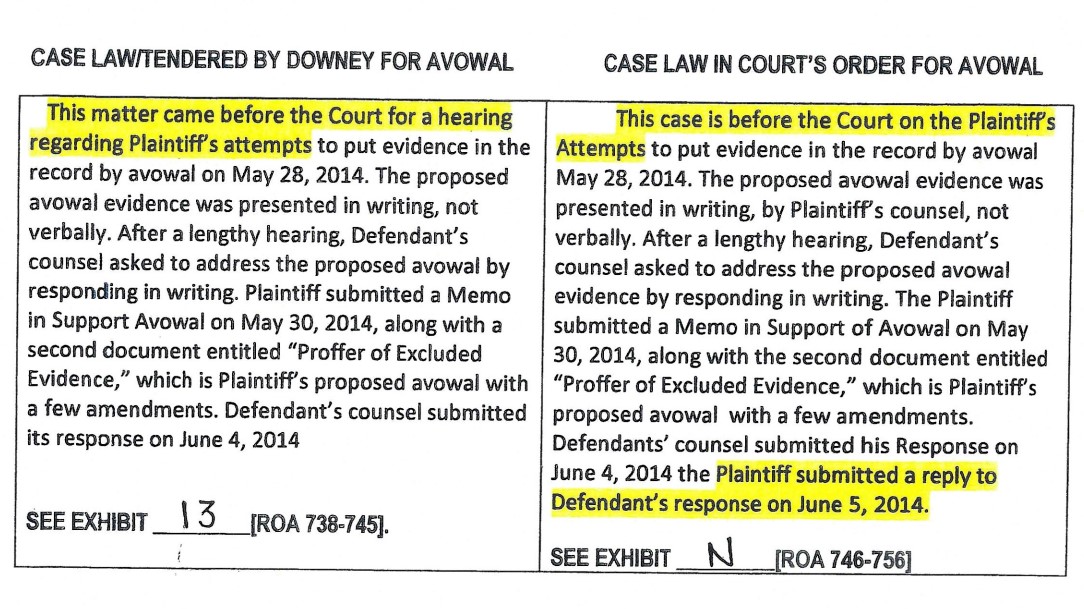
Judge Williams STRUCK CHANDLER’S PURPORTED EVIDENCE AND TESTIMONY AT THE ONSET, and then Post Trial –– Despite endless efforts to get Judge Williams to see reason about the relevancy of all the purported testimony and evidence that she unjustly struck, she falsely sets out:
This case is before the Court on Plaintiff’s Attempts to put evidence in the record by way of Avowal.
Judge Williams Order falsely states that the exact same information which she struck at the onset within Chandler’s Complaint, was NEVER OFFERED in the first place. After the Record on Appeal was created, I was able to show nearly 400 times, in the record, to where the arguments, testimony and evidence were previously submitted to Judge Williams.
But more proof of the intentional bias, and conspiracy between Downey, Moore and Williams, is where Judge Williams began to interchange Limine Order with General Order. The Limine Order was tendered by Downey, and signed on April 14, 2014. As previously discussed, Downey fabricated a great deal of information in that Order, including an alleged agreement. The General Order was given to the parties on the morning of trial. The General Order issued an all-out ban on anything being presented after October 23, 2006.
On December 9, 2014, Judge Williams issued a nonsensical Order, setting out that she did not consider the probate cases relevant to the issues pertaining to mental competency, undue influence, or unnatural disposition. Since she didn’t consider the probate cases to be relevant, they cannot be included within the record on appeal.
Judge Williams completely and entirely ignores that Chandler’s Complaint included an Equity argument, per instructions of District Court Judge Daniel Heady. REGARDLESS…, she personally discussed Mary Katherine’s estate in the December of 2011, Motion to Strike Hearing, and already had personal knowledge about the value of that Mary Katherine’s Estate, during that hearing.
This set off a chain of events within the Court of Appeal filings. I filed a Motion to Amend my Notice of Appeal, to include Judge Williams recent Order, that the Court of Appeals, specifically instructed for me to file, back to the Circuit Court in front of Judge Williams. The only way to appeal that Order, would be to request permission to Amend Chandler’s Notice of Appeal, and include the December 9, 2014, Order.
Downey filed a Response OBJECTING – to Chandler’s Request to Amend his Notice of Appeal to include Judge Williams, recent Order Denying Chandler his legal right to include the two probate cases, that were at the very center of the entire litigation.
RECALL JUDGE WILLIAMS – UNLAWFULLY STRUCK CHANDLER’S EQUITY CLAIM, that was filed per instructions of Probate Judge, Daniel Heady. Judge Williams had heard arguments for years, about the relevancy of all of the stricken paragraphs, including arguments pertaining to Mary Katherine’s Estate, but most importantly, she was fully aware that Downey had already attempted to falsely pad the existing Will Contest Record on Appeal, by falsely asserting within his tendered pretrial(Limine) Order, that Chandler had agreed to not speak about Mary Katherine’s estate, in exchange for the dismissal of the fraudulent counterclaim, that was dismissed, over extremely vocal objections. Even after the inappropriate dismissal, I personally called Downey out, on his attempt to falsely pad the record, with Judge Rene Williams during a recorded telephone conference on April 14, 2014.
Downey’s Response to Chandler’s Motion to Amend his Notice of Appeal, was yet again riddled with fabrications. Downey falsely asserted that during the course of the September 11, 2014, Hearing, which he didn’t even attend, that I submitted the Probate Files for the first time to Judge Williams, and that I had attempted to get the Clerk to include the files, despite the December 9, 2014, Order.
I submitted a Motion to File a Reply to Downey’s fabrication, wherein my tendered Reply addressed all of Downey’s fabrications contained within his Response, and I included a transcript of the September 11, 2015, Hearing, and five separate flash drives of that hearing for the Record.
➡️= GREY➡️ UNRELATED FEDERAL INVESTIGATION INTO UNION COUNTY, KENTUCKY, FOR THE PURCHASE OF 1.5 MILLION DOLLARS OF STOLEN EQUIPTMENT Brucie Moore was the County Attorney and charged with providing sound legal advise to the various county boards. Because the equipment was stolen in another state and purchased by the Union County Government, the FBI, had to get involved because the illegal activities crossed state lines. At all times herein, Brucie Moore and other named individuals knew they had nothing to fear about any type of criminal prosecution, from the State of Kentucky.
Brucie Moore and her husband Charlie Moore, own a thorough horse racing facility at their property in Waverly, Kentucky with the Conway family. It was a joint partnership of Charlie Moore and Thomas Conway, incorporated under the name, WAYMORE, LLC.
As in the former Attorney General, Jack Conway’s father. Thomas Conway was from Union County, and his and Brucie Moore’s family goes way back. Along with Steve Beshear, who originated, just a stone’s throw away, in Dawson Springs, Kentucky. Jack Conway also had an ownership interest in the business, since his mandatory public financial disclosures, shows winnings from the Duke of Waymore. Steven Beshear, Sr., had placed Brucie Moore on the University of Louisville, Board of Trustee. She was serving on the board when the U of L Trustee scandal took place, back in 2014.
SEE MORE ABOUT – HIGHLY JUDICAL CONNECTED PLAYERS OF “THE GOOD OLE BOYS CLUB” IN THE STATE OF KENTUCKY
From January 2015 – February 2, 2015, there were constant filings with the Court of Appeals. I filed a Motion seeking permission to file a brief greater than the twenty-five pages, but less than fifty pages. I thoroughly laid out the sequence of events that had taken place beginning in 2011, throughout litigation, during trial, and within all post-trial filings.
At no time, was I ever appealing the jury verdict. I was appealing the never heard of before, “pre-litigation” Strike Order, Premature evidentiary rulings and exclusions, the Order’s Overruling Chandler’s KRE 103 Filing, simply to preserve the Record, and all other Order’s in between, including of her own Denial to Chandler’s Motion to Recuse, and the subsequent Kentucky Supreme Court, Recusal Denial, rubber stamped by former Chief Justice John D. Minon.
DOWNEY LIED IN EVERY SINGLE FILING WITH THE COURT OF APPEALS. Downey submitted a condescending Response Objecting to all of Chandler’s Motions to submit a Reply to his fraudulent fabricated Responses.
➡️ =GREEN ➡️ related, but separate criminal charges. The Week of February 10, 2015, I received a call from State Attorney Zac Greenwell, letting me know that he dropped the charges against the two individuals who broke into family home, because they were not caught packing anything out of the residence. RECALL THAT … ONE OF THEIR PUBLIC DEFENDERS CALLED ME AND TOLD ME THAT HIS CLIENT WAS FACING 20 YEARS IN PRISON, BECAUSE THEY WERE A PRESISTENT FELONY OFFENDER. Clearly that Defendant caught a real lucky break on this one, or did they simply make another deal?
➡️= Orange ➡️ DISTRICT COURT for MARY KATHERINE’s Estate. The very next day, I received an Order from District Court Probate Judge Daniel Heady, wherein he DENIED Chandler the ability to reopen the Probate Estate of Mary Katherine, due to the equitable defense of laches. Judge Heady just simply signed Moore’s Tendered Order. This in of itself cut off Chandler’s ability to obtain the personal property contained within and on the Chandler/Newcomb family homestead. CHANDLER’S ONLY OPTION WAS TO APPEAL THE DISTRICT COURT JUDGE’S RULING TO CIRCUIT COURT in front of Judge Rene Williams.
Judge Williams was currently on appeal, from failing to recognize Chandler’s Equity claim and his legal vested interest in the personal content of the residence. Judge Williams just signed an Order in December of 2014, denying Chandler the ability to Supplement the Record on Appeal with the two probate cases. When I filed a Notice of Appeal to Judge Heady’s ruling, I also submitted a Motion to Recuse Judge Williams, from reviewing Judge Heady’s Laches Ruling, since she herself was personally on appeal to the Appellate Court for failure to acknowledge Chandler’s legal vested interest in the personal content, at the very beginning of the case, when she fraudulently struck his Equity claim.
It would be illogical and extremely unjust, for a judge to be able to not only reaffirm their own previous rulings, within another action, involving the same parties and the same content, while the initial action was still being Appealed. But in this case, it was even more problematic, for Judge Williams to review the Laches ruling because in essence she is legally cutting off Chandler’s interest in personal property of the homestead, and also attempting to conceal her previous unjust rulings within the Will Contest, pre-trial and post-trial rulings.

➡️= PURPLE ➡️On March 30, 2015, I filed a Civil Action Against Downey, Moore and the two named Defendants for the Misappropriations of Funds, Conversion of personal property, among other counts, just under the one-year statute of limitation, that Downey so vocally placed everyone on notice of.
Landrum & Shouse LLP, out of Lexington, Kentucky, entered an Entry of Appearance on behalf of all named Defendants, (Downey, Moore, and two named Defendants). Landrum & Shouse, filed an Answer on behalf of all named Defendants. All content and filings of this case can be seen under the Civil Action page.
Chandler was extremely concerned and devasted by the Court stripping away his family’s legacy, which included his personal family heirlooms and photos containing snapshots of lifelong memories, both his, and family members going back over 200 years. Those items could NEVER BE REPLACED.
➡️ =ORANGE ➡️ DISTRICT PROBATE COURT FOR THE ESTATE OF KEITH CHANDLER After it became painfully OBVIOUS, that Downey, Moore and Williams were utilizing the two probate cases, to illegally cut off Chandler’s interest to continue any action at all, including his appeal, I filed a Motion Seeking a Complete Accounting of Keith Chandler’s Estate, within the Probate Case in front of Judge Daniel Heady. Chandler’s Motion specifically requested knowledge and information about the whereabouts concerning all personal property that remained or had been removed.
On July 20, 2011, Judge Daniel Heady, initially ordered all items to be placed under lock and key and protected. Brucie Moore informed the Court that the named Executor had made a complete detailed list, right down to a single dollar found in an Old Family Bible. Later when she filed her first inventory in September of 2011, it only included a list of about 40 guns and their serial numbers, or distinct markings.
During the April 29, 2015, Hearing in front of Judge Heady, Moore emphatically proclaimed that because of Judge Heady’s Order on Laches, and because a jury ruled against Chandler, he no longer had a legal interest to request an accounting of the Estate.
During the course of that hearing, I attempted to provide Judge Heady, with a flash drive containing all previous filings in the Will Contest in the Circuit Court Action. The tendered laches order submitted by Moore’s office, post-trial, that Judge Heady signed in February 2015, falsely implied that Chandler’s arguments pertaining to undistributed personal property was litigated and considered by Circuit Court Judge Rene Williams. I simply wanted to make sure Judge Heady, was completely informed about how his Court was being used to conceal fraudulent actions that took place in Circuit Court…as well as, to illegally cut off Chandler’s interest to continue with his appeal on his brother’s estate, and his appeal on Daniel Heady’s laches ruling on his mother’s estate.
MOORE was extremely vocal and persistent against Judge Heady keeping the flash drive, or reviewing anything at all within the Will Contest, Circuit Court Action. Moore first attempted to play the victim, of how she or her clients cannot be held responsible for items missing from the home since it was broken into, and she has no idea about what is going on with that case.
I let her finish, then I said, (the following is in quotations, but it is being paraphrased at the moment, I will upload the video at a later date)
You know that the case was dropped from burglary, to a misdemeanor trespass charge in February. I also find that hard to believe since, you previously claimed to have not even know, who the two individuals were that broke into the home.
After the State Attorney dropped a persistent felony offender, burglary charge, to a misdemeanor trespass charge, I looked their names up, only to discover, both you and Judge Williams had complete and full knowledge of at least one of the Indvidual’s, since the mid 1990’s, when Judge Williams was a District Court Judge.
At which time Judge Heady, turned to me and asked, what were there names? Once I told him, his face changed from a “I am not really interested” expression, to an irritated somber expression. But the change in Moore’s attitude and tone, was undeniable. At this point, Judge Heady, said that Chandler had provided enough evidence that he feels that he would still be entitled to request an Accounting of Keith Chandler’s Estate. At that same time, Moore immediately began asserting that if the Court want’s an accounting to be provided to Chandler, she would comply. (Later within Moore’s Subsequent filings, she called the sequence of events as being voluntary.)
RECALL that I repeatedly plead with the Court of Appeals …. no less than a few dozen times, for them to allow Chandler to submit a Reply to Downey’s fraudulent Responses, simply to protect the veracity of the record.
Then on May 18, 2015, Court of Appeals Order ➡️Returning Appeal to Active Docket and Record to be Certified. ➡️Order Denying Chandler’s Motion to Amend the Notice of Appeal and Statement on Appeal. ➡️Order Passing Chandler’s Motion to Amend the Notice of Appeal to the Panel considering this Appeal on the Merits.➡️Order allowing both parties to have up to 35 pages. (Downey filed an Objection to additional pages, but said, if she gets them, I get them to.) ➡️Order Striking all of CHANDLER’s tendered REPLIES to DOWNEY’s Responses
(Which means Chandler’s Motions seeking to submit a Reply, with his tendered Reply, will not have been seen by the Court of Appeal Judges who were assigned to the merit panel.) So inevitably, despite the non-stop deliberate fabrications set out within Downey’s filings, DOWNEY ALWAYS HAD THE LAST WORD!
Keep this in mind for later, because you will come to learn, that the Kentucky Supreme Court Order suspending me, deliberately and intentionally mischaracterizes many statements and arguments which I presented in my defense, throughout their fraudulent prosecution of me.
Since the burden was on Chandler to ensure that the Court of Appeals was presented with the necessary documentation to support the arguments and issues, that he intended to present on appeal, the COA’s Order passing the issue onto the merit panel assigned to the case, placed Chandler in a conundrum of sorts.
The three-judge merit panel, isn’t even assigned until after the Briefing is complete. I filed a request seeking guidance and clarification, as to whether Chandler should include the probate papers within the appendix, or as an attachment to his brief. Downey Responded with his usual condescending manner, wherein he attempted to mock or belittle me for not understanding the simplicity of the Court of Appeals Order, on the matter. (AGAIN… keep this in mind, for later Kentucky Supreme Court Order Suspending me, from the practice of law.) The actual filings can be found on the Post-trial / Post-Briefing page.
By July 9, 2015, I had not received any ruling or guidance by the Court of Appeals, concerning the conundrum the Court of Appeals, had placed Chandler in. Furthermore, my eldest son, was graduated from bootcamp, and I fully intended to be present. So, I filed a Motion to Extend time for filing Chandler’s Brief by sixty days (60) days, which is a Motion that is routinely granted by the Court of Appeals.
On July 8, 2015, Judge Rene Williams issued a single Order Denying Chandler’s Motion to Recuse her from reviewing Judge Daniel Heady’s Laches Ruling, which illegally cut off Chandler’s interest to his family’s 200 years generational legacy on the farm, as well as Affirming Judge Heady’s Laches ruling, citing to a completely Unrelated United States Supreme Court Case Law on 4th Amendment for Warrantless Searches.
➡️➡️➡️But not for Judge Williams, December 9, 2014, Order Denying Chandler the ability to Supplement the Record on Appeal, Judge Heady would not have signed the laches Order, Judge Williams would not have the unlawful opportunity to reaffirm her previous rulings, that she was already on appeal for.
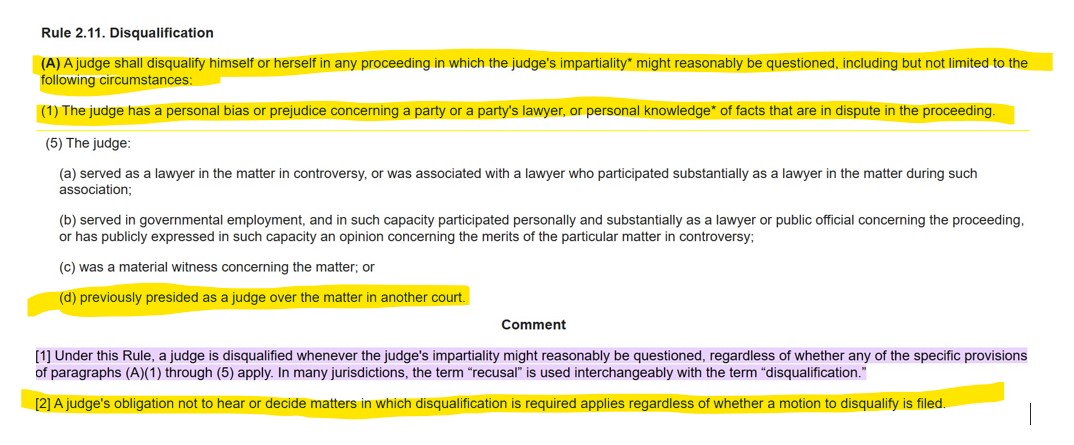
The Supreme Court Rules listed above clearly shows that Judge Williams had an obligation to recuse herself, regardless as to whether Chandler submitted a Motion to Recuse or not. But knowing that she wouldn’t, I filed a Motion to Recuse on behalf of Chandler, and she once again Judge Williams Denied it. Thus, illegally cutting off Chandler’s legal interest to continue with his causes of actions. At this point, there had not been any brief filed with the Court of Appeals. ➡️➡️Once the Civil Action was filed, it became clear that Downey, Moore, and Williams, would stop at nothing to ensure that Chandler’s interest to maintain a lawsuit against them, WOULD BE THWARTED!
After filing the Motion for Extension of time, and having heard nothing back from the Court of Appeals, on my request for extension of time, I telephoned the Court of Appeals, to inquire about my pending motion for extension of time, and pending motion for clarification as to what Chandler was supposed to do, in light of the conundrum the Court of Appeals Order that passed the motion to amend to the merit panel. (Recording phone conversation included within Post-Trial/Pre-Briefing Filing Page.)
The Court of Appeals simply advised me to have something filed by the original due date, despite Chandler’s outstanding Motion for Clarification, and Motion for Extension of time. So that is what I did, I filed a basic draft of Chandler’s Brief, in accordance with the due date. All the while, knowing it was going to get sent back to me for deficiencies. Just to be clear, two weeks prior to the due date. Downey eventually responded to my initial request, graciously granting me 15 additional days to file my brief.
I filed an Objection to the Accounting of the Estate submitted by Attorney Moore in District Court. The bank records and canceled checks provided, clearly showed that Downey was paid $25,000 from the estate, without any type of Court approval. There was a hearing scheduled for July 30, 2015, upon Chandler’s Objection.
THE EVENTS THAT TOOK PLACE NEXT… GOES ONLY TO SHOW THE SELFISH AND POLITICAL NATURE OF THE KENTUCKY JUSTICE SYSTEM AND ALL THOSE WITH THE GREAT POWER TO CONTROL IT!!!
My mother unexpectedly passed away on the morning of July 27, 2015. A colleague of mine filed an Emergency Motion for extension of time to submit Chandler’s Brief, up to and including September 1, 2015.
My colleague also filed an Emergency Motion to Extend Time to file Discretionary Review on Judge Rene Williams refusal to recuse herself, as well as her order affirming the laches ruling.
Downey and Moore both learned about the passing of my mother, on the same day she passed away. Downey sent an email demanding a copy of the draft brief that I filed. Moreover, since Downey was completely aware that I would not be able to attend the District Court Probate Hearing on July 30, 2015.
On July 28, 2015, for the first and only time, Downey submitted an Affidavit to the Court, seeking an after the fact approval, from District Court Probate Judge Daniel Heady, for the funds that he illegally taken, before he would even agree to sign onto the case.
August 3, 2015 — ORDER OF COURT OF APPEALS
D. Lambert; Maze; and Kelly Thompson
Despite having previously filed a Motion for 60 day Extension of time, which is routinely granted, the three judge panel allegedly met on August 3, 2015, to issue one ORDER Denying my Motion for Clarification… .nothing more, just an outright DENIAL.
Both the May, 2015, Court of Appeals Order and the August 3, 2015, Court of Appeals Order contained the signature stamp of Court of Appeals Attorney, Judge Kelly Thompson, from Bowling Green, Kentucky.
August 4, 2015 — Emergency Motion for Extension of time filed by me!
I had to file one myself after someone named Doris, called my office and spoke with my colleague, and informed her that the Court of Appeals could not accept the previous Emergency Motion that she filed on my behalf, because she was not an “attorney of record” on the case.
My colleagues filing was later returned to her office in a handwritten envelope, with nothing more than a post-it note, which simply stated Per our conversations, these are being returned. No notation was ever made of record, until weeks later, when I contacted Samuel Givens. Steven Downey was served on the Emergency Motion, but somehow knew there was no reason for him to submit a response to the one my colleague filed.
Even more evidence that someone at the Court of Appeal level was helping to conceal the true nature of all the filings, was the fact that my colleague filed Emergency Motions for the Will Contest, and Motion seeking additional time to appeal Judge Rene Williams refusal to Recuse herself, from reviewing the Laches Order, and the time to file Discretionary Review on the Laches Order. But those two filings, didn’t get sent back, only the one, that someone knew would be coming.
August 11, 2015 — Downey’s Response to Emergency Motion for Extension of Time, due to my mother’s passing.
Downey asked the Court to Order Chandler’s Brief filed no later than August 21st at the close of business, or Chandler’s Appeal should be dismissed. It had been less than two weeks since I had to bury my mom, Downey was demanding a dismissal. Downey is either heartless or desperate to prevent being exposed for misappropriating $25,000.00 from the Estate.
August 17, 2015 — Chandler’s Motion to Leave to File a Reply to Downey’s Response – with Proposed Reply and Attachments.
I attached the recent periodic accounting from the Estate of Harold Keith, which revealed that Steven Downey was paid $20,000 from the Estate two weeks before trial, and another $5000, post-trial work, and is owed $8,766.50, as of March 23, 2015, and close to $70,000 being owed to Brucie Moore.
See CIVIL ACTION PAGE – On March 30, 2015, I filed a civil action against the defendants, both Downey and Moore for several counts, but in relation to Steven Downey, MISSAPPROPRIATION OF FUNDS.
August 24, 2015 — Downey filed the following: Response to the Motion for Leave to File a Reply To Downey’s Response to Chandler’s Motion to Extend Time to File Brief until September 1, 2015 with attached proposed Reply
-given that it is now August 24, 2015, Downey agrees that I can have until September 1, 2015, to file Chandler’s Brief.
Downey’s Moton to Strike my Motion for Leave to file a Reply to Downey’s Response to my Motion to Extend time to File Brief Until September 1, 2015 with attached proposed Reply.
Downey’s Motion misconstrues the arguments set out within my proposed Reply, attempts to rephrase my statement as accusing him of “billing at excessive rates.” “These allegations have no basis in fact, have no bearing on this case and should be stricken from the record.“
I initially thought that this was great, because for the first time, Downey filed a Motion, which according to him and the Court of Appeals, a Response is the only thing allowed by the Court of Appeal Rules, never subsequent Replies.
August 31, 2015 — My Response to Downey’s Motion to Strike proof of his illegal conduct from the Court of Appeals Record. Each and every time that I submitted proof of Downey’s fabrications, and Downey’s illegal misappropriation, the Court of Appeals Struck from the record.
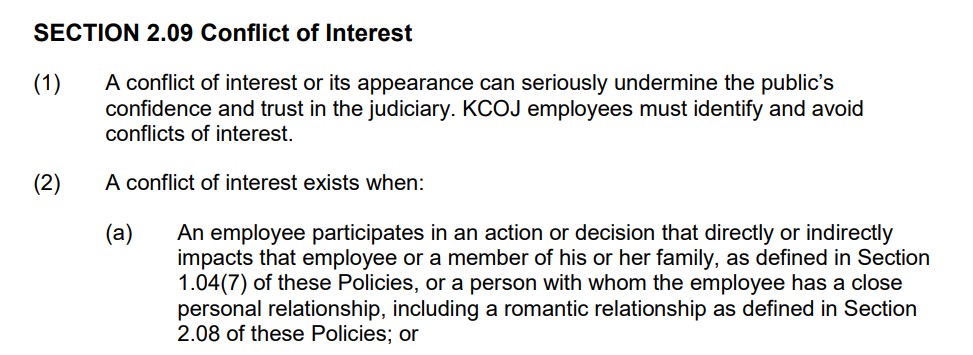
This was about the same time, that I discovered for the first time, that Cynthia Downey, Steven Downey’s sister-in-law, whom he shares jointly owned real estate with, was the COURT OF APPEALS CASE MANAGER FOR NONE OTHER THAN JUDGE KELLY THOMPSON.
RECALL …. ALL REPLIES WERE DENIED BY SIGNATURE STAMP OF Bowling Green, (COA) JUDGE KELLY THOMPSON
I had already filed the Civil Action against Downey, Moore and the Defendants, on March 30, 2015. At that time, Steven Downey’s law office, was not incorporated. Meaning Downey’s personal property and assets would directly be at risk. If Chandler had won a large civil action claim, against the Downey, Moore and defendants, Cynthia Downey’s Joint ownership that her and her husband Richard (Dick) Downey, have with her brother-in-law Steve Downey, would be at stake. So, by the time that the first Court of Appeals Order came out on May 18, 2015, which DENIED all of Chandler’s attempts to correct the truthful nature of the record, Cynthia Downey had a direct interest in the outcome of the case. With them both having the same last name, and being from the same town, collusion can be the only phrase to describe how Cynthia Downey, from Bowling Green, Kentucky was appointed as Court of Appeals case manager for a case, that she had a direct interest in. Plus, it is in direct violations of their own Supreme Court Rules, regarding Conflict of Interest.
THIS WAS THE AHA MOMENT!!!
Downey knew all along that he could say whatever lies that he wanted to, and it didn’t matter, because the Court of Appeals or someone employed by the Court of Appeals was protecting him, from being exposed for his misappropriation of funds, and protecting him from whatever deliberate lies, he submitted within his filings.
SOMETIMES …, YOU HAVE TO HANG BACK — PLAY THE DUMB CARD AND GIVE THE CORRUPT ENOUGH ROPE TO LET THEM HANG THEMSELVES!!!